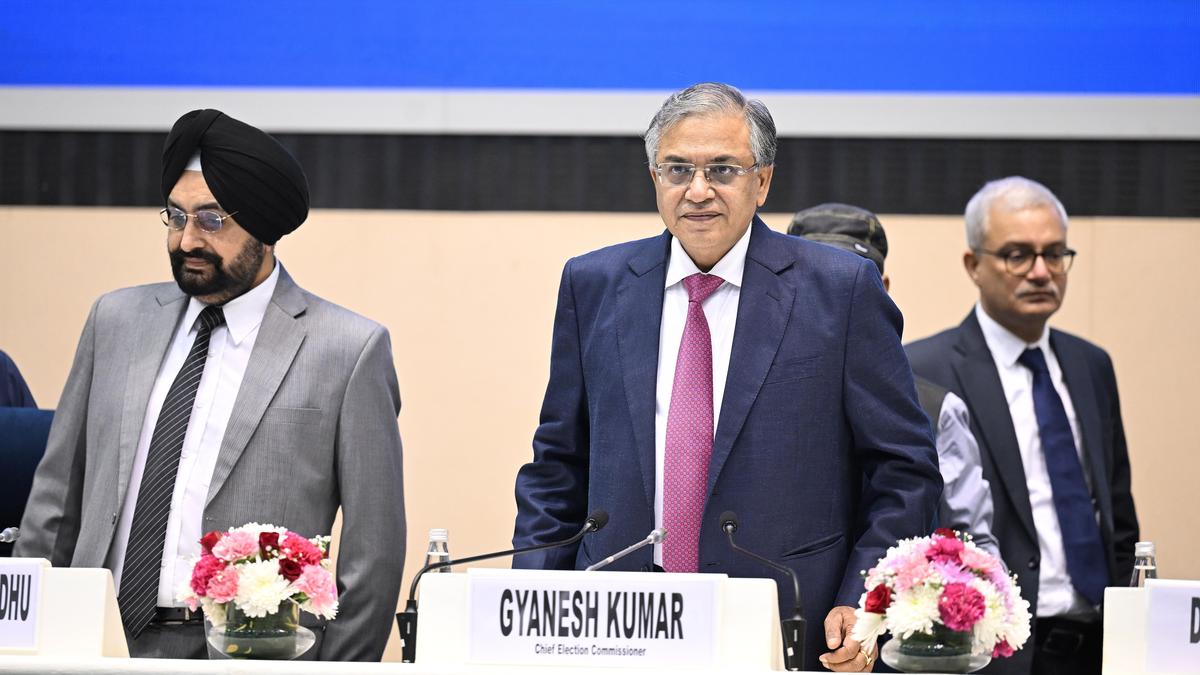
New Delhi: The Election Commission of India (ECI) has defended the constitutional safeguards protecting the Chief Election Commissioner (CEC), stating that the head of the poll panel can be removed only through the same procedure and on the same grounds applicable to a Supreme Court judge. The submission was made before the Supreme Court in response to a petition seeking to restrain Chief Election Commissioner Gyanesh Kumar from functioning in office.
The Election Commission argued that the petition was not legally maintainable and that the allegations against the poll body required careful examination. It also defended its decision-making process and the conduct of the Special Intensive Revision (SIR) of electoral rolls.
The matter has brought renewed attention to the constitutional provisions governing the Election Commission of India, the independence of the Chief Election Commissioner, and the legal procedure for removing a CEC.
Election Commission Cites Article 324(5) of the Constitution
In its counter-affidavit before the Supreme Court, the ECI referred to Article 324(5) of the Indian Constitution. This provision states that the Chief Election Commissioner cannot be removed from office except in the same manner and on the same grounds as a Supreme Court judge.
The Commission argued that a court order restraining the CEC from performing his duties would conflict with the constitutional framework and the applicable legal provisions.
According to the ECI, the petition relied primarily on a newspaper report and did not establish sufficient factual grounds for the extraordinary relief being requested. The Commission also maintained that the petitioner's challenge did not dispute the lawful constitution of the Election Commission or the validity of the CEC's appointment.
ECI Defends Its Decision-Making Process
The Election Commission also addressed concerns regarding how decisions are taken within the multi-member constitutional body.
Under Section 18 of the Chief Election Commissioner and Other Election Commissioners (Appointment, Conditions of Service and Term of Office) Act, 2023, the Commission is required to endeavour to reach decisions unanimously. Where members disagree, decisions are taken by majority.
The ECI stated that matters placed before the Commission undergo deliberation and that relevant files and documents are circulated among the Chief Election Commissioner and the two Election Commissioners for consideration and approval.
It further maintained that the counter-affidavit submitted before the Supreme Court had received unanimous approval from all three members of the Commission.
The Commission argued that restricting the CEC's functioning could disrupt the established legal framework governing the institution and its administrative responsibilities.
Special Intensive Revision of Electoral Rolls
The ECI also defended the Special Intensive Revision (SIR) of electoral rolls, which aims to review and update voter records. The Commission maintained that its decisions concerning the revision exercise were taken in accordance with Article 324 of the Constitution and the applicable statutory framework.
The poll body stated that its orders initiating the SIR process were issued after deliberations and approvals within the Commission. It also rejected allegations concerning changes to Form 6, explaining that the declaration accompanying applications for inclusion in electoral rolls was a separate document prescribed under the SIR orders.
According to the Commission, the revised declaration allows applicants to provide information linking themselves or their parents and grandparents to earlier electoral rolls. This mechanism is intended to help establish eligibility and may reduce the need for additional documents during the claims and objections process.
The ECI also referred to measures intended to assist voters, including visits by Booth Level Officers to collect documents from individuals who receive notices concerning discrepancies or missing links with previous electoral rolls.
How Can the Chief Election Commissioner Be Removed?
The removal of the Chief Election Commissioner follows a stringent constitutional procedure designed to protect the independence of India's election management system.
Under Article 324(5), the CEC can be removed only through the procedure applicable to a Supreme Court judge. Article 124(4) provides that a Supreme Court judge can be removed on grounds of proved misbehaviour or incapacity.
The process requires a motion to be initiated in Parliament. If admitted, an inquiry is conducted into the allegations. For removal to proceed, both the Lok Sabha and the Rajya Sabha must pass the motion with the constitutionally prescribed special majority.
This requires a majority of the total membership of each House and a majority of at least two-thirds of the members present and voting. Once both Houses approve the motion in the same session, the President can issue the order for removal.
These safeguards are intended to prevent the government of the day from removing the CEC merely because of disagreements over electoral decisions.
Why the Supreme Court Case Matters
The dispute highlights the importance of maintaining the independence, transparency and accountability of the Election Commission of India.
As a constitutional body responsible for conducting elections, the ECI plays a critical role in ensuring that the democratic process operates within the framework of the law. The constitutional protection available to the CEC is intended to allow the officeholder to discharge these responsibilities without undue political pressure.
At the same time, legal challenges involving the Commission raise questions about institutional accountability, collective decision-making and the limits of judicial intervention.
The Supreme Court's consideration of the issues will be significant for understanding the legal boundaries governing challenges to the functioning of the Chief Election Commissioner and the broader framework regulating the Election Commission.
The ECI has urged the court to dismiss the petition, maintaining that the relief sought is legally unsustainable.
The proceedings therefore bring together several important constitutional questions, including the security of tenure of the CEC, the authority of the multi-member Election Commission and the legal safeguards governing electoral administration.
Conclusion: The Election Commission's submission reinforces the constitutional principle that the Chief Election Commissioner enjoys strong protection against removal. The case also underlines the importance of following established legal procedures while addressing concerns about the functioning of India's electoral institutions.