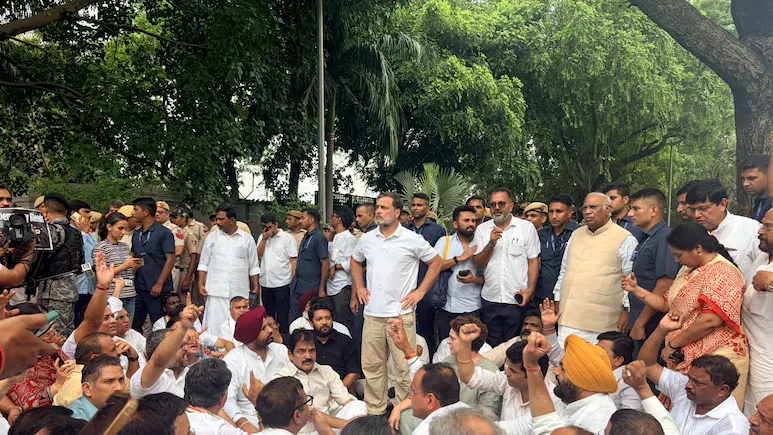
Delhi’s upcoming winter pollution restrictions could complicate travel arrangements for Congress and INDIA bloc supporters planning to attend a major rally at Ramlila Maidan on November 1. The new rules will prohibit certain older petrol and diesel vehicles registered outside the capital from entering Delhi, potentially affecting buses and private vehicles travelling from neighbouring states.
Delhi authorities have made it clear that the restrictions will apply without special exemptions for rally participants. The measures are part of the government’s effort to control air pollution during the winter months, when deteriorating air quality frequently becomes a major concern across the National Capital Region (NCR).
Which Vehicles Will Face Restrictions?
From November 1, 2026, until January 31, 2027, petrol and diesel vehicles registered outside Delhi that do not comply with Bharat Stage-VI (BS-VI) emission standards will be barred from entering the capital.
Electric and compressed natural gas (CNG) vehicles are exempt from this particular entry restriction. Petrol and diesel vehicles meeting BS-VI standards will also be permitted to enter, subject to other applicable regulations. Specified emergency and essential-service vehicles are covered by exemptions.
Separate requirements issued by the Commission for Air Quality Management (CAQM) also restrict the entry of certain buses operating under contract-carriage, tourist and similar permits. These vehicles must meet the prescribed emission requirements, with BS-VI diesel, CNG and electric buses permitted under the applicable rules.
The restrictions could create challenges for organisers arranging transportation from outside Delhi, particularly if some vehicles in their fleet do not meet the required standards.
Thousands of Buses Could Be Involved
The Chamber of Trade and Industry (CTI) has estimated that approximately 15,000 to 20,000 buses could bring participants to the rally, in addition to private vehicles. However, the number of vehicles that would actually be affected by the restrictions remains unclear.
Authorities have deployed 39 enforcement teams around the clock at 13 major border checkpoints and toll plazas to implement the rules. These teams are expected to check compliance as vehicles approach the capital.
Participants travelling from neighbouring cities and states may therefore need to make alternative transport arrangements if their vehicles are not eligible to enter Delhi.
The rally itself has not been cancelled. Delhi Police has issued a no-objection certificate for the gathering at Ramlila Maidan, subject to conditions covering security, crowd management and public order.
Congress Plans Rally Over Electoral Roll Concerns
The November 1 gathering is part of the Congress-led INDIA bloc’s campaign over alleged electoral irregularities and the Special Intensive Revision (SIR) of electoral rolls.
Opposition parties have raised concerns about the revision process and demanded accountability from Chief Election Commissioner Gyanesh Kumar. The Congress has indicated that the rally will proceed despite the transport restrictions and other logistical challenges.
Delhi Police has imposed several conditions on the event. The rally must conclude by 5 pm, and participants cannot remain overnight at Ramlila Maidan. Organisers must also provide CCTV surveillance, adequate drinking water and toilet facilities, and sufficient volunteers for crowd management.
Vehicles bringing participants must be parked at locations designated by the traffic police.
Enforcement Intensifies Amid Pollution Concerns
The restrictions come as Delhi strengthens enforcement against vehicles that violate pollution-control requirements.
Official figures cited by authorities show that 145 buses and 558 overloaded vehicles were impounded between October 11 and 25. During the same period, 4,572 vehicles received challans for invalid Pollution Under Control certificates. Authorities also recorded cases involving visible vehicle smoke and violations related to building materials.
The government has expanded inspections at border checkpoints, pollution hotspots and other locations as part of its winter enforcement measures.
Transport Planning Becomes Crucial
The overlap between the rally and the start of the vehicle restrictions presents a logistical challenge for organisers and attendees. Vehicles that comply with the emission standards can continue to enter Delhi, while those covered by the ban will need alternative arrangements.
The restrictions are intended to address pollution rather than the political event itself. Their practical impact on the rally will depend on the number of non-compliant vehicles involved and how effectively organisers coordinate transportation and parking.
As November 1 approaches, compliance with the entry rules and Delhi Police’s event conditions will be central to managing the expected gathering while enforcing the capital’s winter pollution-control measures.