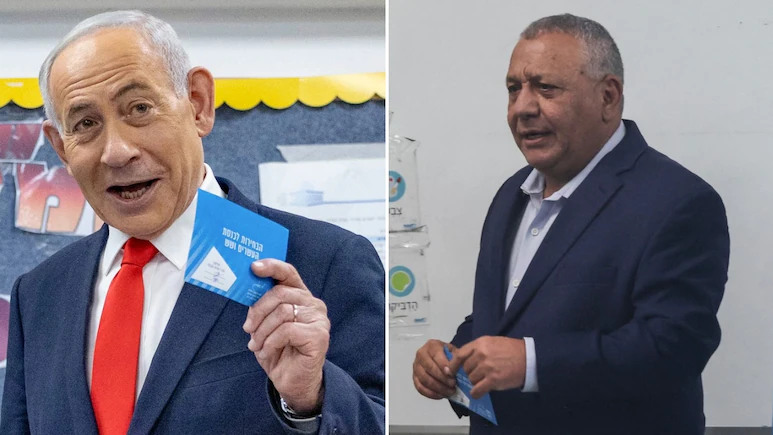
Israel’s general election has produced no clear winner, with exit polls indicating that Prime Minister Benjamin Netanyahu’s governing bloc and the opposition led by former military chief Gadi Eisenkot are both short of the parliamentary majority needed to form a government.
Projections released by Israel’s major television networks on October 27 showed the two rival blocs running almost level, setting the stage for potentially prolonged coalition negotiations. The outcome could leave the country facing weeks of political uncertainty, with the possibility of another election if political parties fail to reach an agreement.
Exit Polls Project a Close Contest
Exit polls published by Kan 11 and Channel 13 projected that Netanyahu’s bloc and Eisenkot’s opposition alliance would each secure around 51 seats in the 120-member Knesset, Israel’s parliament. Arab-led parties were projected to win approximately 18 seats.
Channel 12’s projections showed a slightly different distribution, placing Netanyahu’s bloc at around 52 seats and the opposition at approximately 50.
Under Israel’s parliamentary system, a government needs the support of at least 61 lawmakers to command a majority in the Knesset. Neither side appeared to have reached that threshold in the initial projections.
Exit polls are estimates rather than final results, and the distribution of seats could change as official votes are counted. Final results were expected within the following 48 hours, although negotiations over forming a government could take considerably longer.
Netanyahu’s Likud Remains a Major Force
Despite the uncertain outcome for his broader coalition, Netanyahu’s Likud party was projected to remain the largest individual party in parliament, with approximately 27 seats in revised exit polls.
The result would nevertheless represent a decline from the governing coalition’s previous strength. Netanyahu entered the election leading an alliance of right-wing, far-right and ultra-Orthodox parties that had held a substantial parliamentary majority.
His campaign focused heavily on national security, military operations and his record in confronting regional adversaries. He also highlighted his relationship with US President Donald Trump.
However, criticism of his leadership following the Hamas-led attacks of October 7, 2023, and the conflicts that followed remained central to the election. Questions surrounding security failures, military policy and the government’s approach to ultra-Orthodox military-service exemptions also featured prominently in the campaign.
Gadi Eisenkot Pledges to Form a New Government
Eisenkot, a former Israeli military chief, emerged as Netanyahu’s principal challenger by combining a strong security profile with calls for political change.
Addressing supporters after the exit polls were released, Eisenkot said the results reflected a lack of confidence in Netanyahu’s leadership. He pledged to work quickly to form a new government and argued that voters had expressed a desire for change.
However, the opposition faces its own difficulties. Although several parties want Netanyahu removed from office, they differ on policy and on whether they would support a government dependent on Arab-led parties.
That makes coalition negotiations particularly complicated, even if the final count confirms the opposition’s current position in the exit polls.
Arab Parties Could Influence Coalition Negotiations
Arab-led parties were projected to secure between 17 and 18 seats combined, potentially giving them considerable influence over the next government.
Their parliamentary strength could become decisive if neither of the two main blocs can assemble a majority independently. Yet cooperation with Arab parties remains politically contentious among some opposition factions and is opposed by Netanyahu’s alliance.
The negotiations will therefore depend not only on the final seat distribution but also on which parties are willing to support a coalition and under what conditions.
Political Uncertainty Could Continue
The election’s close outcome leaves Israel facing an uncertain period as parties seek the support needed to establish a government. If negotiations fail, the country could eventually return to the polls.
Until a new administration is formed, Netanyahu would remain caretaker prime minister, retaining the responsibilities and powers associated with that role.
The final results and subsequent coalition talks will determine whether the opposition can assemble a governing majority or Netanyahu can remain in office through a new political arrangement. For now, the exit polls point to a fragmented parliament in which negotiations, rather than a decisive electoral victory, will determine the next stage of Israel’s political future.