Israel's inconclusive parliamentary election has created uncertainty over the country's next government, with potential consequences extending beyond the Middle East. For India, the political deadlock presents a diplomatic challenge: maintaining its growing strategic partnership with Israel while protecting important economic, energy and connectivity interests involving Iran and the Gulf region.
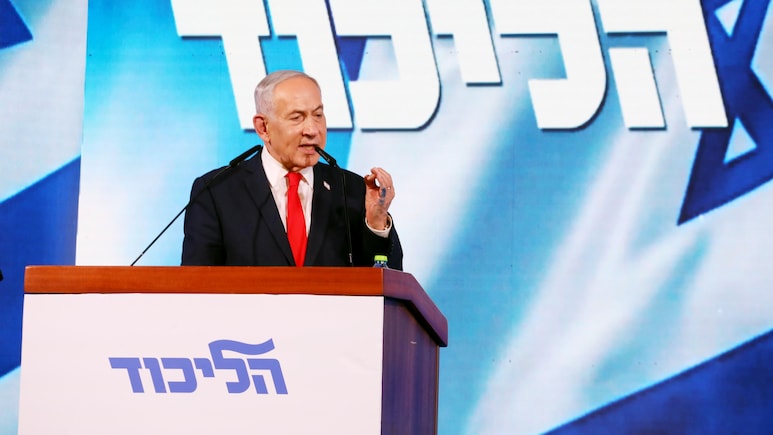
The October 27 election failed to give either major political bloc the 61 seats required to form a majority in the 120-member Knesset. Prime Minister Benjamin Netanyahu's Likud-led alliance secured 53 seats, while the opposition grouping led by former military chief Gadi Eisenkot won 48. Arab-led parties achieved a record combined total of 19 seats.
The result has left coalition negotiations uncertain and raised questions about the direction of Israel's foreign policy during a period of continuing regional tensions.
Netanyahu's Political Future Remains Uncertain
Netanyahu's alliance emerged with the largest number of seats but fell short of the parliamentary majority needed to govern independently. The opposition also lacks sufficient numbers to form a government without additional support.
President Isaac Herzog is expected to consult political representatives before assigning a candidate the responsibility of forming a coalition. If negotiations fail, Israel could face another election.
Several possible arrangements are under discussion, including a government led by Netanyahu, an opposition-led coalition supported by Arab parties or a broader unity government. However, political disagreements have made each option difficult.
The Arab parties' increased parliamentary representation gives them greater potential influence, although leading politicians from both major camps have expressed reservations about relying on their support.
Iran Could Remain a Major Security Concern
The election comes amid continuing tensions between Israel and Iran. A change in Israel's leadership may affect diplomatic messaging and the government's approach to regional security, but it does not necessarily mean a fundamental shift in policy.
Eisenkot, a former chief of the Israeli military, has taken a firm position on Iran and Hamas. He has also opposed Palestinian statehood, suggesting that a change in prime minister would not automatically produce a different approach to the region's most difficult disputes.
For India, the consequences of further escalation could be significant. A renewed confrontation involving Iran could threaten energy infrastructure, shipping routes and commercial activity across the Gulf.
India imports substantial quantities of energy and depends on stable maritime routes for trade. Any prolonged disruption could increase transportation and insurance costs, create uncertainty in energy markets and affect domestic economic conditions.
Gaza's Future Remains Unresolved
The election has also done little to clarify the future of Gaza. Both Netanyahu and Eisenkot have supported the demand that Hamas be disarmed, while major disagreements remain over the territory's future governance and the prospects for Palestinian statehood.
A new Israeli administration could change the tone of diplomatic engagement with Washington and other international partners. It could also influence discussions concerning humanitarian assistance, security arrangements and the wider political framework for Gaza.
However, the election has not produced a clear political consensus on a settlement involving Palestinians.
For India, developments in Gaza carry diplomatic importance because New Delhi maintains relations with Israel as well as Arab countries and continues to support a negotiated two-state solution.
Why India-Israel Relations Matter
India's relationship with Israel has expanded considerably beyond traditional defence purchases. Cooperation now covers military technology, artificial intelligence, cybersecurity, agriculture, water management, space research and trade.
Prime Minister Narendra Modi's February 2026 visit to Israel elevated bilateral ties to a Special Strategic Partnership for Peace, Innovation and Prosperity. Both countries also agreed to deepen cooperation in defence production and emerging technologies.
A change in Israel's political leadership may influence the diplomatic atmosphere, but existing defence agreements, research programmes and commercial relationships are built on long-term cooperation. These connections are unlikely to disappear simply because a new coalition takes office.
India will nevertheless need to establish effective working relationships with whichever political leadership emerges from the negotiations.
Gulf Interests Complicate India's Diplomatic Choices
India's wider interests in West Asia make the situation particularly complex. The Gulf region is an important source of energy, trade, investment and employment for millions of Indian nationals.
India also maintains strategic and connectivity interests in Iran, particularly through the development of Chabahar Port, which provides access to Afghanistan and Central Asia without relying on Pakistan.
Meanwhile, projects such as the India-Middle East-Europe Economic Corridor depend on regional stability and cooperation among multiple countries.
A prolonged Israel-Iran confrontation could complicate these initiatives and affect India's commercial interests. New Delhi therefore has reasons to preserve its relationship with Israel while maintaining diplomatic channels with Tehran and Arab capitals.
A Diplomatic Balancing Act for New Delhi
Israel's election has changed the parliamentary balance without resolving the country's political direction. Coalition negotiations could produce a new leadership arrangement, a unity government or another election.
For India, the central challenge is to protect its strategic partnership with Israel without weakening its relationships across the wider region. The outcome of Israel's political negotiations will influence the diplomatic environment, but India's approach will continue to depend on its broader security, economic and energy interests.
The coming weeks could therefore be important not only for Israel's domestic politics but also for New Delhi's efforts to maintain a balanced and independent West Asia policy.