Spain is facing growing public anger following a devastating high-speed train collision that killed at least 68 people and injured around 80 others. The disaster has triggered demonstrations in Madrid, with protesters demanding accountability from the government and calling for the resignation of Prime Minister Pedro Sánchez and Transport Minister Óscar Puente.
The protests took place outside the Transport Ministry on Wednesday night, October 28, as questions mounted over railway safety and the authorities’ response to the accident. Demonstrators accused the government of failing to protect passengers and demanded a transparent investigation into the circumstances surrounding the collision.
Demonstrators Clash With Police in Madrid
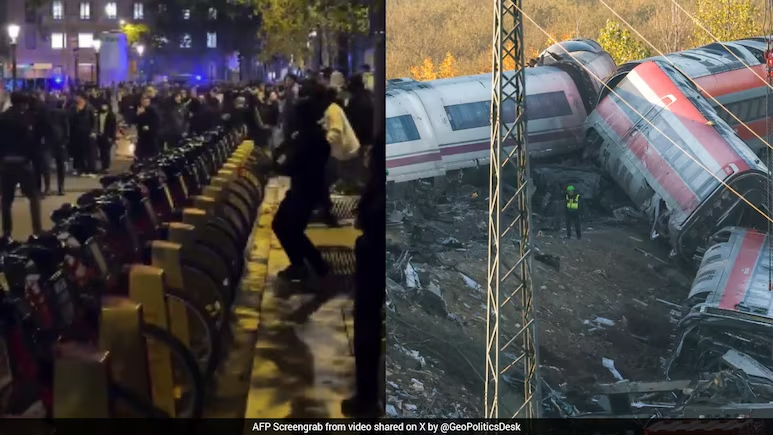
Hundreds of people gathered outside the ministry, with reports putting the crowd at around 1,500. Some protesters threw bottles and flares towards police officers, prompting law enforcement personnel to use tear gas to disperse the gathering.
Demonstrators carried banners with anti-government slogans and chanted against Transport Minister Óscar Puente, whom some blamed for the disaster. The clashes intensified as police attempted to clear the area.
The demonstrations reflected wider frustration over public infrastructure and government accountability. Reports said no injuries or arrests had been confirmed following the confrontation.
What Happened in the Train Collision?
The accident occurred on October 28 near Urda in Spain’s Toledo province, on the high-speed railway route connecting Madrid with Seville.
A Renfe train, operated by Spain’s state-owned railway company, struck the rear of a stationary train belonging to private operator Iryo. Both trains were travelling along the same route, and the collision caused carriages to derail.
According to regional authorities, 397 passengers were aboard the Renfe service, while the Iryo train was carrying 147 people. At least 68 people died, and approximately 80 others were injured, including several in critical condition.
Emergency teams worked at the scene to rescue passengers and assist the injured. The scale of the disaster made it one of the deadliest railway accidents in Europe in recent years.
Signalling Failure Under Investigation
Initial information from the Transport Ministry pointed to a failure in the LZB signalling system, which helps regulate train movements and maintain safe distances between services.
The malfunction reportedly affected a stretch of approximately 63 kilometres and caused several trains to stop automatically. Control of train movements was subsequently transferred to a railway operations centre.
Transport Minister Puente said the control centre authorised the Renfe train to resume normal operations despite the signalling problem. The decision has become a major focus of the investigation, with questions about how the train was permitted to continue while another service remained stationary ahead.
The precise sequence of events and the responsibility of individual officials remain subjects of investigation. Authorities have promised to establish what happened.
Second Deadly Rail Accident This Year
The latest collision has intensified concerns because Spain experienced another major high-speed railway disaster in January 2026. That accident, near Adamuz in Córdoba province, killed 46 people and involved trains operated by the same two companies.
The recurrence of fatal incidents has raised questions about infrastructure maintenance, signalling technology and safety procedures across the national railway network.
Prime Minister Sánchez announced three days of national mourning beginning October 29 and pledged a full investigation. He said any negligence or system failures would have to be addressed.
Political Pressure Builds Ahead of Elections
The accident has placed additional pressure on Sánchez’s government ahead of Spain’s scheduled November 29 general election. Opposition figures have demanded accountability, while calls for Puente to resign have grown louder.
Railway safety is now emerging as a central issue in the political debate. Railway workers and unions have also raised concerns about working conditions and the handling of the investigation.
The government faces the challenge of restoring public confidence while rescue and investigative work continues. The findings of the inquiry are expected to play an important role in determining responsibility and identifying measures needed to prevent another tragedy.