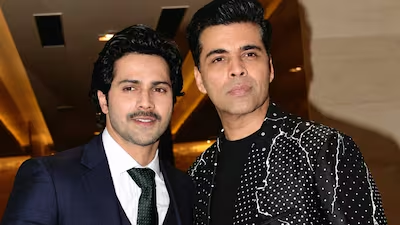
Bollywood actor Varun Dhawan has opened up about a heated disagreement with filmmaker Karan Johar, revealing that their professional relationship has not always been free of conflict. The actor recalled an argument in which he confronted Johar directly, telling him to stop behaving like a child.
The revelation offers a glimpse into the disagreements that can emerge behind the scenes in the Hindi film industry, even between people who share a longstanding professional association. Dhawan, who made his Bollywood debut with Student of the Year, has worked closely with Johar and his production house on several projects.
The actor discussed the incident during a conversation on Koffee With Karan Season 9, where he appeared alongside Janhvi Kapoor. Their discussion touched on professional relationships, differences of opinion and the challenges of navigating the film industry.
Varun Dhawan Opens Up About His Disagreement With Karan Johar
Dhawan recalled that the argument with Johar became intense enough for him to speak bluntly to the filmmaker. According to the actor, he told Johar to stop acting like a child during the confrontation.
The incident demonstrated that their relationship, despite its history of collaboration, has also involved moments of frustration. Dhawan did not present the disagreement as evidence of a permanent breakdown in their association, but rather as an example of how tensions can arise when people have strong opinions.
Working relationships in the film industry often involve creative decisions, commercial expectations and personal dynamics. When disagreements develop, they can become particularly difficult to manage because professional and personal connections frequently overlap.
Dhawan’s account suggested that he felt comfortable enough to address Johar directly rather than allowing the disagreement to remain unresolved.
A Longstanding Professional Association
Johar played an important role in launching Dhawan’s career through Student of the Year in 2012. The film also introduced Alia Bhatt and Sidharth Malhotra to Bollywood, making it a significant debut project for all three actors.
Since then, Dhawan has built a varied filmography spanning romantic comedies, family dramas, action films and mainstream entertainers. His work has included titles such as Humpty Sharma Ki Dulhania, Badlapur, Badrinath Ki Dulhania and October.
Johar, meanwhile, has remained an influential filmmaker and producer through Dharma Productions, which has backed numerous Hindi-language films and helped launch or develop the careers of several actors.
Their professional connection has continued beyond Dhawan’s debut, making the actor’s recollection of their argument notable to audiences familiar with their history.
Why Disagreements Matter in the Film Industry
Creative collaborations can place filmmakers and actors under considerable pressure. Directors and producers may have particular expectations for a project, while performers may disagree with decisions about scripts, scenes, schedules or the broader direction of a film.
Such disagreements do not necessarily signal that a professional relationship has ended. In many cases, people working together must find ways to communicate their concerns and move forward despite differences.
Dhawan’s recollection illustrates that even established industry relationships can involve uncomfortable conversations. His willingness to describe the confrontation also offers a reminder that public-facing partnerships may have a more complicated history than audiences see on screen or at promotional events.
Varun Dhawan’s Candid Side Draws Attention
The actor’s comments have attracted interest because they offer a more personal account of his interactions with one of Bollywood’s prominent filmmakers. While audiences often see celebrities together at film launches, award ceremonies and promotional events, their professional relationships can involve disagreements that rarely become public.
Dhawan’s story sheds light on that less visible side of the industry. His account focuses on a moment when frustration led him to confront Johar directly, rather than keeping his concerns to himself.
The recollection also places their relationship in a broader context of collaboration, differing perspectives and the need to manage conflict in a demanding professional environment.