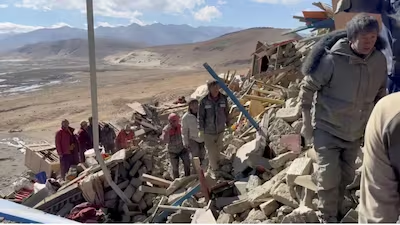
A powerful magnitude 7.0 earthquake struck China's Tibet Autonomous Region late on Thursday, October 22, 2026, killing at least 16 people and injuring dozens as buildings collapsed and emergency teams rushed to affected communities. More than 300 homes were reported collapsed or damaged, while authorities continued assessing the scale of destruction and coordinating rescue operations.
The earthquake struck at approximately 10:33 pm local time in the Baqen County area of Nagqu, northern Tibet. The tremor was felt across surrounding areas, prompting residents to leave buildings and gather outside as concerns grew over structural damage and possible aftershocks.
The disaster has triggered an emergency response involving police officers, firefighters and rescue personnel. Officials are working to locate injured residents, assess damaged buildings and restore essential services in affected communities.
Earthquake Triggers Building Collapses and Injuries
Initial reports indicated that at least 16 people had died in the earthquake. The number of injured varied between early official updates, with some reports recording 32 injured and others putting the figure at 46. Several people were reported to be in serious condition.
Authorities reported that at least 339 houses had collapsed or sustained damage. Some livestock shelters were also affected, adding to the difficulties faced by residents in the remote region.
Videos released after the earthquake showed people rushing out of restaurants and other buildings as the ground shook. Footage from supermarkets showed objects falling from shelves, illustrating the intensity of the tremors inside commercial establishments.
Buildings in the affected area sustained visible cracks, while some structures suffered roof collapses. Rescue workers used flashlights to examine damaged properties and search for people who might need assistance.
Officials cautioned that the damage assessment remained incomplete as teams continued reaching communities near the epicentre.
Where Did the Earthquake Strike?
The earthquake's epicentre was located near Maru Township in Baqen County, within Nagqu in northern Tibet. The region lies at a high altitude and includes sparsely populated mountainous terrain, which can make emergency access difficult.
Seismic monitoring agencies recorded the earthquake at magnitude 7.0, with the initial estimates placing its depth at approximately 10 to 18 kilometres, depending on the agency's measurements.
The epicentre was roughly 190 kilometres east-northeast of Nagqu and around 390 to 400 kilometres from Lhasa, the regional capital.
The tremor was also felt in other parts of Tibet and neighbouring areas. Smaller aftershocks were recorded following the main earthquake, raising concerns about the stability of already damaged buildings.
Power and telecommunications services were disrupted in parts of the affected county, complicating communication and relief efforts.
Rescue Teams Mobilised as Emergency Operations Continue
Local authorities deployed more than 300 police officers to support relief work, while the regional fire and rescue service mobilised 347 personnel for operations in affected areas.
Emergency teams began inspecting damaged buildings, assisting injured residents and helping people move away from potentially unsafe structures. Authorities also initiated emergency response measures to coordinate the deployment of personnel and equipment.
The difficult terrain, high elevation and possibility of further tremors have added to the challenges facing rescuers. Officials must assess whether damaged buildings can be safely entered while ensuring that medical assistance reaches those who need it.
The full extent of the losses remains subject to verification as more information becomes available from villages and other affected locations.
Tibet's History of Major Earthquakes
The latest earthquake has renewed concerns about seismic hazards across the Himalayan region and western China, where powerful earthquakes have caused significant casualties in the past.
In January 2025, an earthquake in Tibet's Tingri County killed at least 126 people and damaged thousands of homes. Another major earthquake in neighbouring Qinghai Province in 2010 caused extensive loss of life.
The latest disaster once again highlights the vulnerability of remote communities to strong ground movement, particularly where emergency access and communications can be limited.
Rescue and relief operations remain underway, with authorities continuing to verify casualties, assess infrastructure damage and determine the assistance required by affected residents.