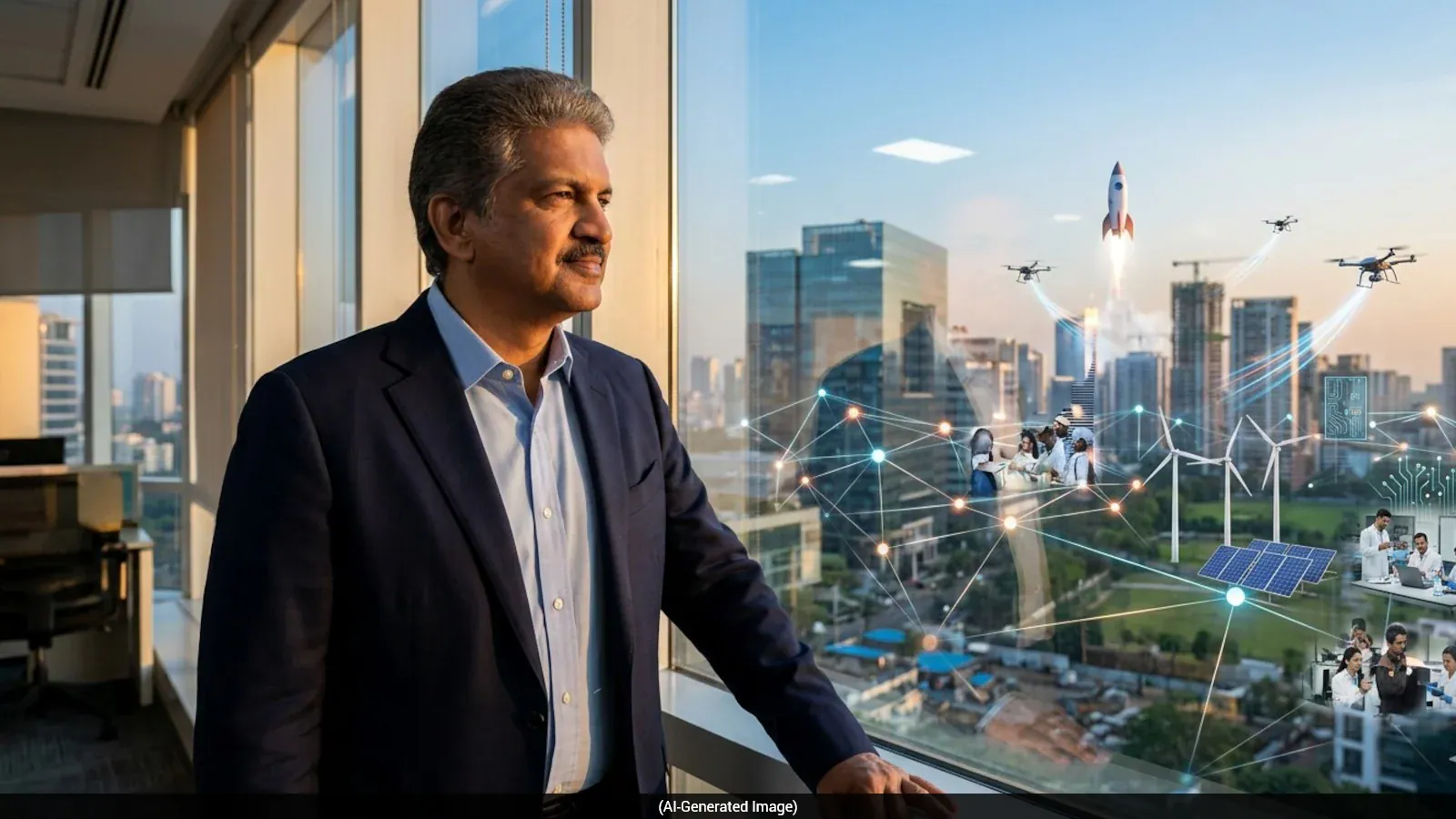
Mahindra Group Chairman Anand Mahindra has praised India's growing startup ecosystem, highlighting a shift towards deep technology, advanced manufacturing, specialised hardware and innovative chemical processes. In a social media post on October 19, 2026, he said the country's entrepreneurial momentum extended well beyond software, pointing to young founders developing technologies that could strengthen India's industrial and scientific capabilities.
Mahindra's comments reflect growing attention towards Indian startups working on complex engineering and research-driven products. These businesses are attempting to develop technologies that have traditionally depended on foreign expertise, including advanced manufacturing systems, speciality chemicals and emerging energy technologies.
He also highlighted the work taking place in laboratories, workshops and factories across the country, describing it as an indication of the wider technological activity developing within India's startup community.
Deeptech Emerges as a Major Focus
India's startup ecosystem has historically been associated with software services, e-commerce, financial technology and digital platforms. However, a growing group of entrepreneurs is now concentrating on businesses that require specialised research, engineering and manufacturing capabilities.
Deeptech startups typically develop products based on scientific research or advanced engineering. Their work can involve longer development periods and higher initial costs than conventional software businesses, but successful innovations may create valuable intellectual property and open new industrial markets.
Mahindra highlighted manufacturing technology, advanced hardware and chemical processes as areas that particularly interested him. These sectors could help Indian businesses develop domestic capabilities while creating products for customers in international markets.
His remarks also drew attention to the role of younger entrepreneurs willing to pursue technically demanding projects rather than relying exclusively on established business models.
Scimplify Brings Science and Manufacturing Together
Among the companies highlighted in the discussion was Bengaluru-based Scimplify, which operates in speciality chemicals and advanced materials.
The company focuses on connecting research and product development with manufacturing. Its work spans materials and chemical applications relevant to industries such as life sciences, crop sciences and emerging energy technologies.
Scimplify's operating model combines research capabilities with a network of manufacturing and technical partners. This approach is intended to help businesses move from developing chemical processes to producing materials at commercial scale.
The company represents one example of startups seeking to build technology-led industrial businesses in India, where scientific expertise and manufacturing infrastructure must work together to meet customer requirements.
Ethereal Machines Develops Advanced Manufacturing Technology
Another company highlighted was Bengaluru-based Ethereal Machines, which develops computer numerical control (CNC) machining technology.
CNC systems use computer-controlled processes to manufacture components with precision. They are widely used in industries where accuracy, repeatability and complex component designs are important.
Ethereal Machines has developed its own three-axis and five-axis CNC platforms. Such equipment can help manufacturers produce intricate parts for a variety of engineering applications.
Developing domestic capabilities in advanced machinery is important because specialised manufacturing equipment can play a significant role in the competitiveness of industrial businesses.
The company's work illustrates how Indian startups are moving beyond providing software and services to building physical products and industrial technologies.
Pranos Fusion Energy Explores Next-Generation Energy
Pranos Fusion Energy was another venture featured in Mahindra's post. The company is working on technologies associated with nuclear fusion, an area of research that seeks to generate energy by combining atomic nuclei.
Its development work includes tokamak technology, design software, control systems and high-temperature superconducting magnets. These components are relevant to the development of fusion systems, which remain technically challenging to engineer and operate.
Commercial fusion energy has attracted international scientific and industrial interest because of its potential long-term energy applications. However, substantial engineering and research challenges remain before it can become a widely deployed commercial power source.
Pranos Fusion Energy's inclusion highlighted the breadth of technological ambitions emerging from India's startup sector.
A New Book Examines India's Startup Potential
Mahindra also welcomed The Lift-Off Nation, a book by Rajan Anandan, former head of Google India and managing director at Peak XV Partners, and entrepreneur Saurabh Srivastava.
The book examines India's startup ecosystem and the conditions that could support further entrepreneurial growth. Mahindra viewed its central theme as consistent with the technological developments he had highlighted.
His comments point towards a broader question facing India's economy: whether startups can translate technical innovation into globally competitive products, manufacturing capabilities and sustainable businesses.
Turning Innovation Into Long-Term Growth
India's expanding deeptech ecosystem presents opportunities across industrial manufacturing, chemicals, machinery and energy technology. Yet research-intensive businesses must overcome challenges involving funding, product development, specialised talent and commercialisation.
For these startups, long-term success will depend on converting promising research into reliable products that customers are willing to adopt.
Mahindra's message reflects confidence in the entrepreneurs pursuing that challenge. Their progress could help broaden India's startup story from digital services towards a more diverse economy built on scientific research, advanced engineering and domestically developed technology.