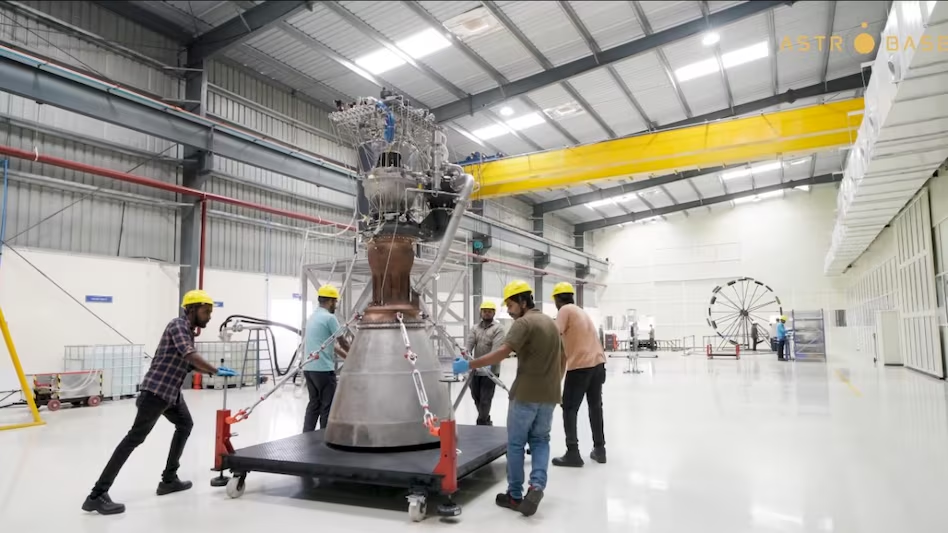
India’s private space industry has reached a significant technological milestone with the unveiling of EVEREST, an advanced rocket engine developed by Bengaluru-based Astrobase Space Technologies. Designed to generate 800 kilonewtons (kN) of thrust, the engine uses a sophisticated propulsion system associated with SpaceX’s Raptor engines and could support India’s ambitions to develop reusable rockets and expand its commercial space capabilities.
The announcement, made in August 2026, marks an important step towards building advanced rocket propulsion technology within India. However, the engine must undergo full-scale combustion testing and further qualification before its performance and suitability for operational launch vehicles can be established.
Astrobase’s EVEREST Engine Brings Advanced Propulsion to India
EVEREST is an 80-tonne-class, liquid oxygen and liquid methane-powered rocket engine based on Full-Flow Staged Combustion (FFSC) technology. The system has been designed and integrated in India, placing the country among a small group pursuing one of the most complex architectures in modern liquid rocket propulsion.
The engine’s stated thrust capacity of 800 kN makes it a potential candidate for future medium-lift launch vehicles. These rockets could eventually transport satellites and other payloads into orbit, depending on the final vehicle design and the engine’s demonstrated performance.
Astrobase Space Technologies was founded in 2024 by entrepreneur Neeraj Khandelwal and Devakumar Thammisetty, a former Indian Space Research Organisation (ISRO) propulsion specialist. The company is working to establish domestic capabilities for designing, manufacturing and testing advanced rocket engines.
What Makes Full-Flow Staged Combustion Technology Different?
Rocket engines rely on turbopumps to deliver fuel and oxidiser into a combustion chamber at extremely high pressure. The efficiency of this process directly influences engine performance and the amount of propellant required to generate thrust.
In conventional gas-generator engines, some propellant is burned to drive the turbopumps, and the resulting exhaust is released without contributing fully to the main combustion process.
Full-Flow Staged Combustion takes a different approach. It uses two preburners, one operating with excess fuel and the other with excess oxidiser. The resulting gases drive separate turbine systems before entering the main combustion chamber.
This configuration can improve propellant utilisation and support high operating pressures. It also introduces considerable engineering challenges involving materials, thermal management, turbomachinery and system integration.
SpaceX’s Raptor engine family has demonstrated the technology in flight through the Starship programme. EVEREST’s unveiling represents progress in India's development efforts, but it does not yet establish performance parity with an operational engine such as Raptor.
Testing Will Determine the Engine’s Future
The next major challenge is demonstrating that EVEREST can operate reliably under full-scale conditions. The company previously conducted a hot-fire test of a smaller version of its engine in 2025 and carried out turbopump testing in 2026.
These earlier activities provide development experience, but the complete engine still requires full-scale hot-fire trials and a broader qualification programme. Repeated testing will be important for assessing combustion stability, component durability and performance across operating conditions.
Astrobase also has facilities in Bengaluru and Andhra Pradesh to support engine assembly, manufacturing and propulsion testing. Its development programme has received support through the Indian National Space Promotion and Authorization Centre’s Technology Adoption Fund.
Why the Development Matters for India’s Space Sector
Reusable launch vehicles are an important goal for the global space industry because recovering and reusing major rocket components can potentially reduce launch costs and shorten turnaround times. Achieving these benefits, however, requires reliable propulsion systems, recovery technology and extensive flight testing.
For India, developing an indigenous high-thrust FFSC engine could strengthen the domestic supply chain and reduce dependence on foreign technology in a strategically important area. It could also give private launch companies access to propulsion capabilities suited to more demanding missions.
The commercial opportunity is growing as satellite operators seek regular access to orbit for communications, Earth observation and other applications. Yet the transition from an unveiled engine to a commercially viable launch system will require substantial technical validation and investment.
EVEREST therefore represents a promising engineering milestone rather than a completed breakthrough in reusable spaceflight. Its eventual significance will depend on how successfully Astrobase progresses through full-scale testing, vehicle integration and flight demonstrations.
If those stages are completed successfully, the project could become an important contributor to India’s emerging private launch ecosystem.