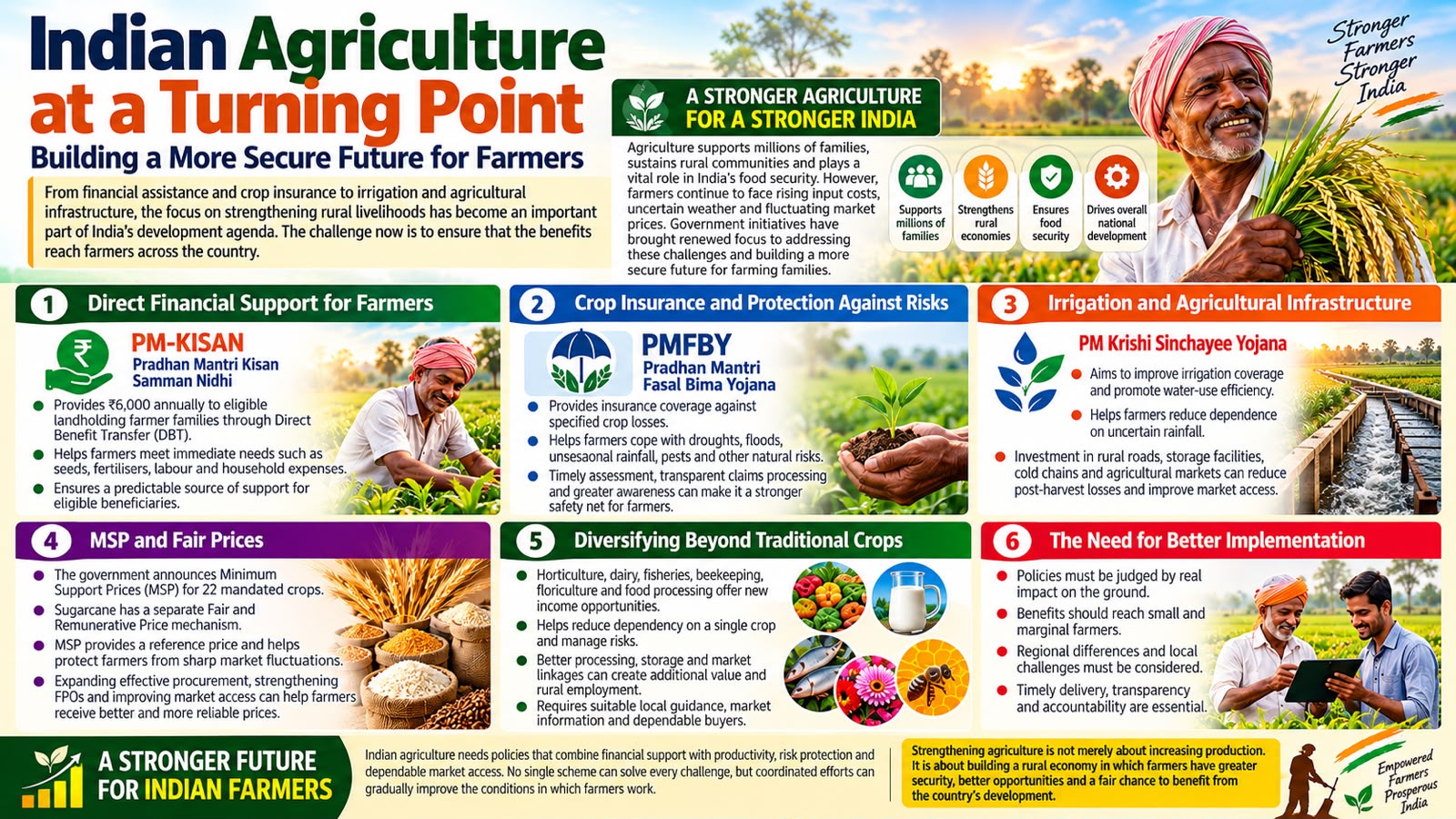
From financial assistance and crop insurance to irrigation and agricultural infrastructure, the focus on strengthening rural livelihoods has become an important part of India's development agenda. The challenge now is to ensure that the benefits reach farmers across the country.
Agriculture in India is more than an economic activity. It supports millions of families, sustains rural communities and plays a vital role in the country's food security. For generations, farmers have worked under uncertain conditions, balancing rising input costs, unpredictable weather and fluctuating market prices. For many small and marginal farmers, even a single difficult season can have lasting financial consequences.
Against this backdrop, agricultural policies introduced and expanded under the BJP-led central government have sought to address several longstanding concerns, including income support, access to institutional credit, crop losses and irrigation. While the impact of these measures varies across regions, they have brought renewed attention to the need for a more comprehensive approach to rural development.
Direct Financial Support for Farming Families
One of the most prominent initiatives is the Pradhan Mantri Kisan Samman Nidhi (PM-KISAN), which provides eligible landholding farmer families with ₹6,000 annually through direct benefit transfers, subject to the scheme's eligibility requirements.
The significance of direct transfers lies in their simplicity. Farmers can use the money according to their immediate needs, whether for seeds, fertilisers, agricultural labour or household expenses. Although this assistance cannot cover the full cost of cultivation, it provides a predictable source of supplementary income for eligible beneficiaries.
The broader lesson is that agricultural support must remain accessible, timely and responsive to the realities of small farming households. Accurate beneficiary records and effective grievance redressal are equally important to ensure that eligible farmers are not left out.
Crop Insurance and Protection Against Uncertainty
Agriculture remains vulnerable to droughts, floods, unseasonal rainfall, pests and other risks that farmers cannot always control. The Pradhan Mantri Fasal Bima Yojana (PMFBY) was introduced to provide insurance coverage against specified crop losses, subject to the scheme's conditions.
Crop insurance can help reduce the financial shock caused by a poor harvest. However, its effectiveness depends on timely assessment, transparent claims processing and farmers' awareness of the coverage available to them.
Improving these areas is essential to making agricultural insurance a dependable safety net rather than a facility that farmers struggle to access when they need it most.
Irrigation and Better Agricultural Infrastructure
Water availability remains one of the defining challenges for Indian agriculture. Farmers who depend heavily on rainfall often face considerable uncertainty, particularly when monsoons are delayed or unevenly distributed.
Initiatives such as Pradhan Mantri Krishi Sinchayee Yojana seek to improve irrigation coverage, promote water-use efficiency and encourage more sustainable water management. Better irrigation infrastructure can help farmers reduce their dependence on uncertain rainfall and make cultivation more productive, although outcomes depend on local conditions and implementation.
Investment in rural roads, storage facilities, cold chains and agricultural markets is also important. These facilities can reduce post-harvest losses, improve access to buyers and help farmers retain more value from their produce.
MSP and the Question of Fair Prices
For farmers, the price received after months of work often matters as much as the quantity harvested. The Minimum Support Price (MSP) system is intended to provide a reference price for selected agricultural commodities and support farmers against sharp market fluctuations.
The central government announces MSPs for 22 mandated crops, while sugarcane has a separate Fair and Remunerative Price mechanism. However, the announcement of an MSP does not mean that every farmer can sell every crop at that price. Actual procurement varies by crop, state, agency and prevailing arrangements.
Expanding effective procurement where appropriate, improving market access and strengthening farmer-producer organisations can help address the gap between announced support prices and the prices farmers actually receive.
A sustainable agricultural policy must recognise that farmers need not only higher announced prices but also reliable buyers, transparent weighing practices and reasonable access to markets.
Supporting Farmers Beyond Traditional Crops
India's agricultural future cannot depend on cereals alone. Horticulture, dairy, fisheries, beekeeping, floriculture and food processing offer opportunities for farmers to diversify their income.
Government initiatives supporting horticulture development, agricultural infrastructure and farmer-producer organisations can help cultivators explore these opportunities. Better processing and storage can also reduce wastage and create additional employment in rural areas.
Diversification is particularly important where water resources are limited or the cultivation of a single crop exposes households to repeated financial risks. However, farmers need suitable local guidance, market information and dependable buyers before making costly changes to their cultivation practices.
The Need to Measure Progress on the Ground
Agricultural policy cannot be judged by announcements alone. Its real value becomes visible when a farmer receives an insurance payment on time, gains access to irrigation, obtains a fair price or avoids losing a significant portion of the harvest.
The BJP-led government's agricultural initiatives address several important aspects of the rural economy, from direct financial assistance to irrigation and crop insurance. Their long-term success, however, will depend on consistent implementation, accountability and the ability to respond to farmers' changing needs.
Regional differences also matter. A farmer cultivating paddy in eastern India faces different challenges from a horticulture grower in southern India or a cultivator working in a water-stressed district. Agricultural policy must account for these differences instead of relying on a single approach for every region.
A Stronger Future for Indian Farmers
Indian agriculture needs policies that combine financial support with productivity, risk protection and dependable market access. No single scheme can resolve every challenge, but coordinated efforts can gradually improve the conditions in which farmers work.
The emphasis on farmer welfare under the present government has placed several important issues at the centre of the national development agenda. The next step is to strengthen delivery, improve access to agricultural infrastructure and ensure that small and marginal farmers benefit alongside larger producers.
Ultimately, the success of agricultural policy will be reflected in the confidence of farming families: their ability to invest in the next crop, withstand an unexpected setback and earn a reasonable livelihood from their work.
For India, strengthening agriculture is not merely a matter of increasing production. It is about building a rural economy in which farmers have greater security, better opportunities and a fair chance to benefit from the country's development.
By - Dr. Nawaz Ahmad Khan
Professor, ND University, Ayodhya, Uttar Pradesh