While Dussehra celebrations across India traditionally feature the burning of Ravana’s effigy to symbolise the victory of good over evil, a village in Uttar Pradesh follows a markedly different tradition. In Bisrakh Jalalpur, near Greater Noida, devotees honour Ravana through prayers and religious rituals, remembering him as a learned scholar and a devoted follower of Lord Shiva.
The temple associated with this tradition offers a distinctive perspective on one of the most familiar figures in the Ramayana. Rather than focusing exclusively on Ravana as the antagonist defeated by Lord Rama, the local community places emphasis on his knowledge, spiritual devotion and connection with the village.
Why Is Ravana Worshipped in Bisrakh?
According to local belief, Bisrakh is the birthplace of Ravana. Residents associate the village with his father, sage Vishrava, and believe that the settlement's name is derived from the sage's name.
These traditions have become an important part of the village's cultural and religious identity. For many residents, Ravana is not simply the ten-headed king remembered during Dussehra festivities but also a learned Brahmin and a powerful devotee of Lord Shiva.
His reputation as a scholar and spiritual figure forms the basis of the community's distinctive approach to worship.
However, the belief that Ravana was born in Bisrakh is a local religious tradition rather than a historically established fact.
Inside the Temple Dedicated to Ravana
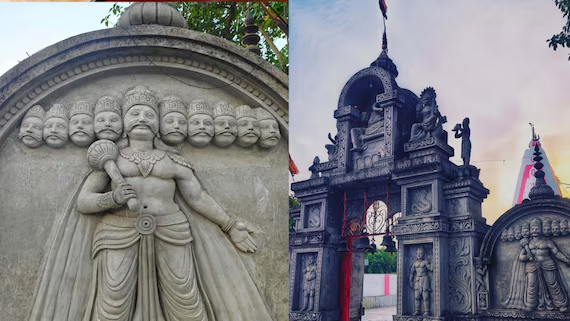
The temple, commonly known as the ancient Shiv Mandir or Ravana temple, has a significant connection with Lord Shiva. Its inner sanctum centres on a Shiva lingam, reflecting the traditional belief that Ravana was among Shiva's most devoted worshippers.
Interestingly, the temple has not always featured a permanently displayed full idol of Ravana. Carvings and representations across the temple complex depict important aspects of his life, including his roles as a scholar, ruler and warrior.
During Dussehra, the temple's rituals differ from the celebrations seen in many other parts of the country. Instead of burning Ravana's effigy, devotees gather for prayers, havans and other religious ceremonies.
An idol of Ravana is brought out for worship during the annual observances, according to descriptions of the temple's practices. The rituals reflect the community's emphasis on his perceived virtues and spiritual legacy.
How Dussehra Is Celebrated Differently
Dussehra, also known as Vijayadashami, commemorates Lord Rama's victory over Ravana in the Ramayana and is widely associated with the destruction of evil.
In Bisrakh, however, the festival is observed through a different religious lens. Residents do not follow the customary practice of burning Ravana's effigy. Instead, they perform prayers and other ceremonies to honour the figure they regard as a significant part of their local heritage.
The contrast highlights the diversity of India's religious traditions, where regional beliefs and community histories can shape how familiar mythological figures are remembered.
Ravana's character has long been interpreted in different ways across literary, religious and cultural traditions. In Bisrakh, his learning and devotion to Shiva receive particular attention.
Where Is Bisrakh and How Can Visitors Reach It?
Bisrakh Jalalpur is located in Greater Noida, in Uttar Pradesh's Gautam Buddha Nagar district. The village lies within the wider National Capital Region and can be reached by road from Delhi, Noida and Greater Noida.
Visitors can travel by car or taxi, while those using the metro will need onward road transport to reach the temple. Travel time depends on the starting point and traffic conditions.
The temple remains a place of worship rather than simply a tourist attraction. Visitors should respect local customs and avoid disrupting religious ceremonies.
For those interested in Indian mythology and regional traditions, Bisrakh offers an opportunity to understand how communities preserve distinctive interpretations of figures who occupy central places in the country's epic narratives.