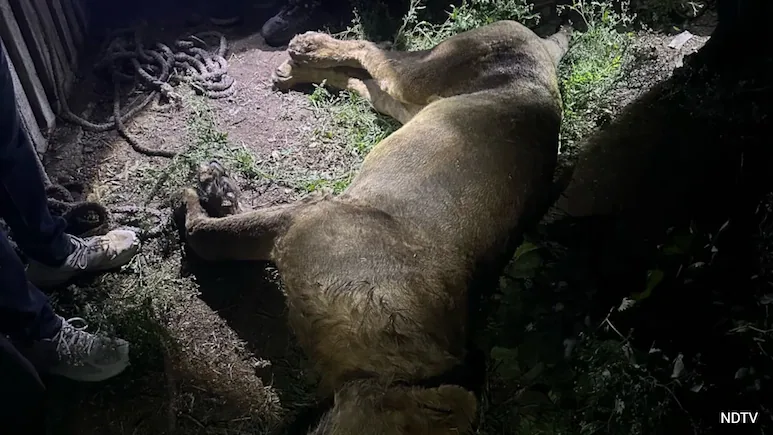
A young Asiatic lion died after falling into a farm well in Jira village in Gujarat’s Amreli district, prompting renewed concerns about the dangers agricultural infrastructure poses to wildlife living around the Gir landscape.
The incident occurred at approximately 1:30 am on Thursday, November 19, in Dhari taluka, within the Dalkhaniya forest range. The lion, estimated to be between two and three years old, fell into a well located on farmland owned by a local farmer.
Despite the presence of a parapet wall around the well, the animal fell into the water and drowned, forest officials said.
Forest Department retrieves lion’s carcass
After receiving information about the incident, a Forest Department team reached the site and began an operation to recover the lion’s body from the well.
In-charge Assistant Conservator of Forests Mitesh Vaniya said the animal had fallen into the well on the outskirts of Jira village. The carcass was subsequently retrieved by forest personnel.
A post-mortem examination confirmed drowning as the cause of death. Officials reported no evidence of poaching, foul play or other suspicious activity connected to the incident.
The findings indicate that the death was accidental, although the circumstances have once again drawn attention to the risks faced by lions when they move through agricultural land outside protected forest areas.
Farm wells remain a threat to Asiatic lions
The Gir landscape in Gujarat is the principal habitat of the Asiatic lion. These animals frequently move beyond forest boundaries into agricultural fields and revenue areas, bringing them into closer contact with human settlements and farm infrastructure.
Wells used for irrigation can become dangerous obstacles, particularly when their openings are inadequately protected. Even when a well has a raised boundary, an animal may still fall inside if the surrounding structure does not provide sufficient protection.
Such incidents are not isolated in the region. In January 2023, an adult lion and a lioness reportedly drowned after falling into an open well in the Tulsishyam range of the Gir East forest division. A separate lion was rescued from a well in the Dalkhaniya range around the same period.
Earlier in 2026, three lion cubs also died in separate incidents across Amreli district in a single day, including one within the Dalkhaniya range.
These cases underline the continuing challenges of protecting wildlife in areas where natural habitats overlap with farming activities.
Protective measures need continued attention
The Gujarat Forest Department has constructed parapet walls around thousands of agricultural wells in Amreli and Gir Somnath districts to reduce the risk of animals falling into them.
However, the latest death suggests that additional safeguards may be necessary at vulnerable locations. Protective grills or secure covers over well openings could help prevent wildlife from falling into water-filled structures.
Regular inspections and cooperation between forest officials and farmers could also help identify wells that remain hazardous despite existing boundary walls.
Measures to secure farm infrastructure are particularly important in areas frequented by lions, where wildlife movement across agricultural land is a regular occurrence.
Balancing farming and wildlife conservation
The death in Jira village highlights a broader conservation challenge in Gujarat: protecting Asiatic lions while allowing agricultural activity to continue around their habitat.
Preventing such accidents requires more than responding after an animal has fallen into a well. Identifying high-risk locations, strengthening protective structures and encouraging farmers to adopt wildlife-safe practices could help reduce avoidable fatalities.
Although officials found no indication of poaching or deliberate harm in this case, the loss of another young lion demonstrates the risks posed by everyday infrastructure.
For wildlife conservation efforts in the Gir region, ensuring that agricultural wells are adequately secured remains an important step towards reducing accidental deaths and safeguarding the state’s iconic big cats.