Union Parliamentary Affairs Minister Kiren Rijiju has demanded an apology from the Congress party, accusing it of circulating a fabricated artificial intelligence (AI) video intended to damage the reputation of the Indian Army. The political dispute comes amid heightened attention to reports of military face-offs between Indian and Chinese troops along the Line of Actual Control (LAC) in Arunachal Pradesh.
Rijiju’s remarks followed a series of warnings from the Indian Army about manipulated videos and misleading social media posts making claims about Chinese activity along the border. The developments have raised concerns about the spread of false information during a sensitive period for India’s national security.
Rijiju Accuses Congress of Spreading Misleading Content
Rijiju criticised the alleged circulation of the AI-generated video and called on Congress to apologise to the country. He described the incident as a serious matter, arguing that content targeting the Army’s credibility could undermine public confidence in the armed forces.
The minister’s remarks added to the political confrontation over the handling of information related to the India-China border. The allegation against Congress, however, remains distinct from the Army’s independently documented fact-checks of specific misleading videos.
The episode highlights the growing role of manipulated digital content in political disputes, particularly when claims involve military operations and territorial security.
Indian Army Debunks Video Claiming China Took Control of Arunachal Areas
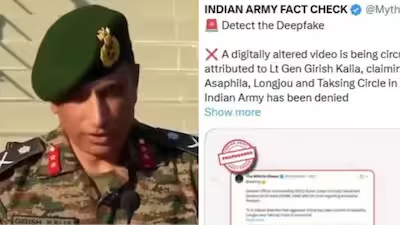
The Indian Army recently flagged a digitally altered video that falsely attributed statements to Lieutenant General Girish Kalia. The clip claimed that China had taken control of Asaphila, Longju and Taksing Circle in Arunachal Pradesh and that Indian troops deployed in the region had been denied essential supplies.
The Army clarified that the video used old footage with fabricated remarks. The original recording dated to October 27, 2023, when Kalia, then a major general, briefed the media in Kupwara, Jammu and Kashmir, about counter-infiltration operations.
The original briefing discussed security operations along the Line of Control, including foiled infiltration attempts and the recovery of weapons and narcotics. It contained no statements about Chinese control of territory in Arunachal Pradesh or restrictions on supplies to Indian troops.
The Army urged the public to verify original footage and consult reliable information before sharing videos concerning military operations.
Other Misleading Videos Circulate Amid Border Tensions
The manipulated clip is part of a wider series of misleading posts circulating online amid reports of face-offs between Indian and Chinese forces along the LAC.
Other examples include footage of a security drill in Karnataka falsely presented as Chinese soldiers searching Indian personnel in Arunachal Pradesh. Officials also challenged claims that Chinese commercial vehicles seen near Nathu La in Sikkim represented an unauthorised incursion into Indian territory.
In another instance, footage of a military exercise involving Kazakhstan’s special forces was shared with claims that it showed an India-China confrontation.
These examples demonstrate how genuine footage can be stripped of its original context, edited or paired with false captions to create an inaccurate impression of events.
The authorities have urged social media users to check the location, date and original source of such material before drawing conclusions about border developments.
Border Developments Remain a Sensitive Issue
The controversy comes after Indo-Tibetan Border Police Director General Shatrujeet Kapur said on October 22 that Indian and Chinese troops had faced off at multiple locations along the LAC in Arunachal Pradesh.
The border remains sensitive because India and China have differing perceptions of sections of the frontier. Reports of confrontations have therefore drawn political scrutiny and renewed attention to the government’s handling of border security.
Accurate reporting is particularly important in this context, as unverified claims can create confusion about military activity and diplomatic developments.
AI-Generated Disinformation Raises New Challenges
The latest episode underscores the challenges posed by AI-generated audio, altered video and fabricated statements. Such content can make it appear that public officials or military officers have said things they never actually said.
The Army’s fact-checking efforts have focused on identifying the original recordings and explaining how they were misrepresented. Officials have also urged people to avoid forwarding unverified material, particularly when it concerns national security.
Rijiju’s demand for an apology has intensified the political debate surrounding the alleged video. The broader issue remains the need to distinguish verified military information from manipulated content as India continues to monitor developments along its border with China.