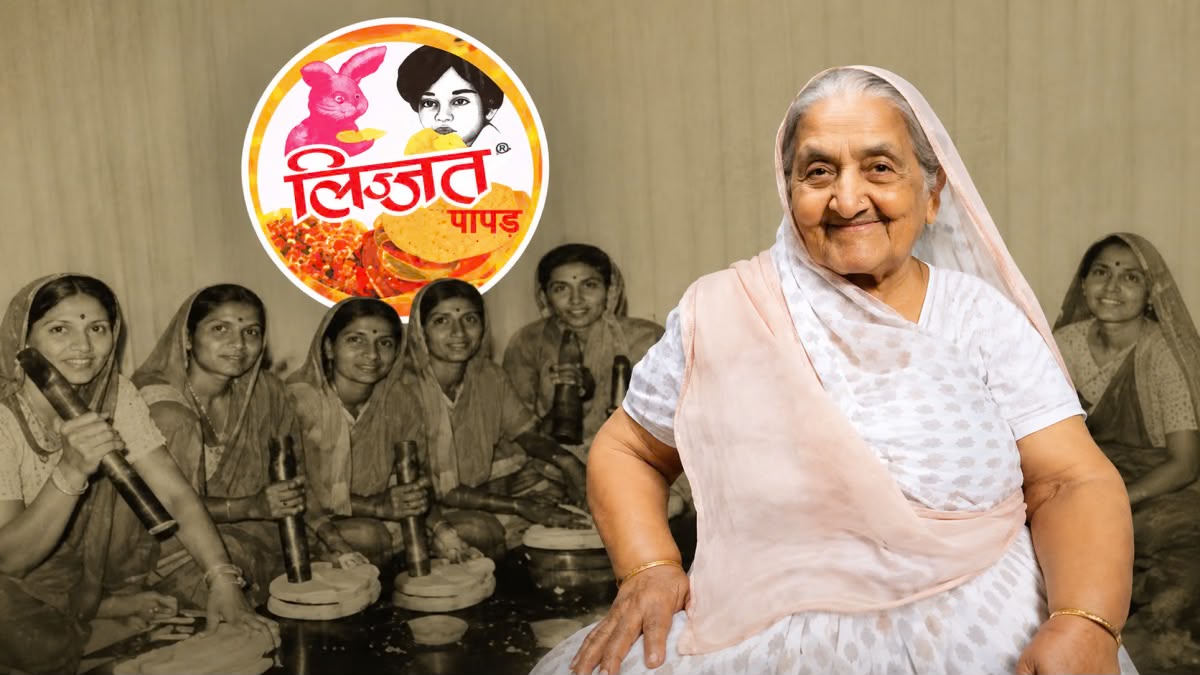
More Than a Papad Story
The story of Lijjat Papad is often presented as an inspiring tale of seven women starting a small home-based business. Its business significance, however, goes much deeper. Over more than six decades, Lijjat developed a women-led cooperative model that combined distributed production, shared ownership and disciplined growth.
The organization became a striking example of how a consumer business can scale without following the conventional path of external investment and centralized manufacturing.
Seven Women and ₹80
The journey began on 15 March 1959, when seven women started rolling papads on the terrace of a chawl in Girgaum, Mumbai. Their original objective was simple: create an additional source of household income.
The group began with only ₹80 in borrowed capital, with social worker Chhaganlal Karamsi Parekh providing guidance. An important early principle was to expand by adding members rather than simply hiring employees. New women would participate as owners of the collective, helping shape the structure that later became central to Lijjat's growth.
Ownership at the Centre
Lijjat operates through a cooperative-style system in which member-sisters are paid for their production and participate in the economic benefits of the organization. Instead of building the business around outside shareholders, the model keeps the community of women at its centre.
That creates a strong connection between production and responsibility. Members have a direct interest in maintaining quality because the reputation and performance of the organization affect the wider collective.
The organization operates as Shri Mahila Griha Udyog Lijjat Papad, with its governance rooted in its membership.
A Distributed Production Network
Lijjat does not depend on a conventional large-scale papad factory. Branches prepare dough according to standardized processes, after which members collect measured quantities, take them home, roll the papads and return the finished products.
The products are then checked, weighed and recorded at the branch. This arrangement allows production capacity to grow through membership rather than requiring equivalent expansion of factory infrastructure.
The approach is especially notable because it combines centralized quality standards with decentralized production, creating a model that can operate across multiple communities.
Keeping Quality Consistent
A home-based manufacturing network presents an obvious challenge: maintaining uniformity across thousands of production points. Lijjat's system addresses this through standardized dough preparation and inspection of returned products.
Substandard papads can be rejected, while the member-ownership structure creates an additional incentive to protect the collective brand. The system shows that distributed production does not necessarily mean uncontrolled production when processes and accountability are clearly defined.
Beyond Papads
Over time, Lijjat expanded into products including spices, vermicelli, atta and detergents. Its products have reached markets across India and international destinations, particularly areas with established Indian communities.
The expansion is significant because it shows that the cooperative model was not limited to one product. The organization was able to apply its underlying principles to a broader consumer-goods portfolio while retaining its distinctive ownership structure.
Lessons for Modern Businesses
Lijjat's most relevant lesson for today's entrepreneurs may be its interpretation of community. Modern brands often build communities around customers, followers and loyalty programmes. Lijjat built a community that was directly involved in producing and owning the business.
Its history also challenges the idea that scale always requires large factories, rapid fundraising or aggressive diversification. Patient compounding, distributed capacity and operational simplicity can create a different route to long-term growth.
Recognition has included repeated awards associated with the village-industry sector, while founding member Jaswantiben Jamnadas Popat received the Padma Shri in 2021 in the trade and industry category.
Publicly reported turnover and membership figures vary by year and source, so individual numbers should be treated cautiously. What remains clear is the larger achievement: a women-led cooperative that began with seven women and a very small amount of capital developed into a durable consumer enterprise.
Lijjat Papad is therefore not merely a story about papads. It is an Indian case study in community ownership, distributed manufacturing and long-term business building.