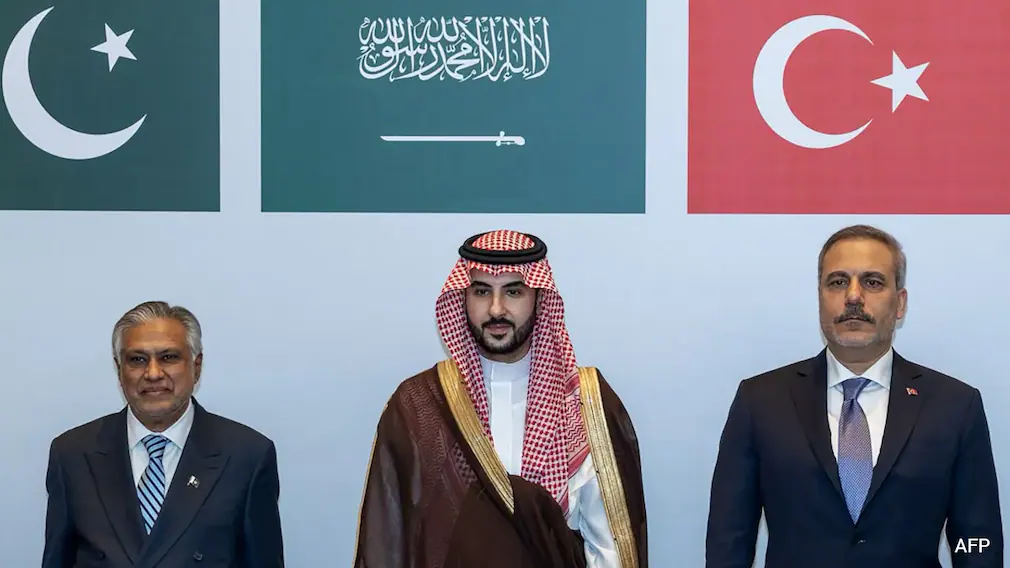
The security partnership between Pakistan, Saudi Arabia and Turkey has entered a new phase after the three countries agreed to begin practical implementation of their joint defence commitments. The decision comes as Saudi Arabia faces renewed attacks linked to Yemen’s Houthi conflict, raising fresh questions about how far the newly established alliance could go.
The Makkah Joint Defence Agreement was signed on August 7, 2026, by Saudi Arabia, Pakistan and Turkey. Its central principle is collective defence: an armed attack against one member is to be treated as an attack against all three. The agreement was designed to strengthen deterrence and expand defence cooperation among the participating countries.
The pact's first major test came amid a sharp escalation in Yemen. Saudi-backed forces have been fighting to regain strategically important territory from the Iran-aligned Houthi movement, while attacks have targeted Saudi cities and infrastructure. The fighting has increased concerns about the security of Saudi territory and vital regional transport routes.
Three Countries Move Toward Operational Cooperation
On October 5, senior foreign and defence officials from Pakistan, Saudi Arabia and Turkey met in Riyadh under the Strategic Political and Defence Committee established by the agreement. The meeting produced a decision to move immediately toward implementing collective defence commitments and arranging the agreed military capabilities for rapid deployment in Saudi Arabia, subject to each country's national laws.
The development is significant because the agreement is moving beyond political declarations and into an institutional framework. The three countries have already established mechanisms for cooperation, while a permanent secretariat is being developed in Saudi Arabia. Pakistan has also been selected to provide the alliance's first secretary-general for a three-year term.
However, the announcement does not automatically mean that Pakistani or Turkish forces will enter offensive combat operations in Yemen. The precise nature of military assistance remains important. Current reporting indicates that support could include defensive capabilities, intelligence, logistics, technical assistance and protection of critical infrastructure rather than direct participation in every battlefield operation. Turkey's parliamentary ratification process is also relevant to the scope of its formal military participation.
Why Pakistan Faces a Difficult Balancing Act
For Islamabad, the pact presents both strategic opportunities and significant risks. Pakistan has close defence and economic ties with Saudi Arabia but also shares a long border with Iran. Direct involvement in an expanding regional confrontation could therefore create diplomatic and security complications.
Pakistan's likely priority is to protect Saudi territory while limiting the possibility of being drawn into a wider offensive campaign. That distinction could become one of the most important tests of the agreement's collective-defence principle.
The pact also comes at a time when Pakistan is dealing with security challenges closer to home. Its ability to allocate military resources and diplomatic attention to the Middle East while managing its own regional concerns will be closely watched.
What It Means for the Region
The activation of the agreement signals that Saudi Arabia is seeking stronger regional security arrangements rather than relying entirely on external military guarantees. For Pakistan and Turkey, closer cooperation with Riyadh could expand their strategic influence across the Gulf and wider Muslim world.
At the same time, the alliance's credibility will depend on what its members actually do during a prolonged crisis. The agreement has established a collective-security framework, but questions remain over troop commitments, command arrangements, rules of engagement and the precise circumstances that would trigger deeper military involvement.
For now, the Mecca pact represents a significant shift from a newly signed agreement toward an operational security partnership. Its response to the Yemen conflict could ultimately determine whether it develops into a durable regional defence mechanism or remains primarily a political and deterrence-oriented arrangement.