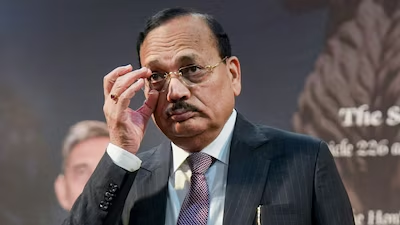
The Supreme Court of India on Friday issued contempt notices to all office-bearers of the Kerala Pradesh Congress Committee (KPCC) over a controversial social media post targeting Chief Justice of India Surya Kant. The court stressed that judicial independence cannot be undermined by political pressure and warned that freedom of expression cannot be used to intimidate the judiciary or interfere with the administration of justice.
A bench comprising Justices Aravind Kumar and Vipul M Pancholi took up the matter following a petition seeking action over the post published on the official X account of the Congress's Kerala unit. The court has sought an explanation from the party's office-bearers on why contempt proceedings should not be initiated against them.
What Did the Controversial Post Say?
The controversy began on October 12, when the Kerala Congress's official social media account published a message directed at Chief Justice Surya Kant.
The post stated: “Dear Surya Kant, If law and order is not your domain, resign now. We will find your replacement who can handle it.”
The message drew criticism for directly demanding the resignation of the Chief Justice. It was subsequently deleted after attracting widespread attention.
The post emerged amid political tensions surrounding protests and legal proceedings related to law-and-order issues. The incident prompted questions about the limits of political criticism when it is directed at the head of the country's judiciary.
Supreme Court Warns Against Intimidation of Judiciary
During the hearing, the bench underlined the constitutional importance of judicial independence and said no individual or political organisation could place itself above the Constitution.
The judges observed that judicial decisions remain open to criticism, even strong criticism. However, they cautioned that freedom of expression cannot be used as a shield for intimidation or interference with the administration of justice.
The bench also emphasised that the authority of the court rests on the Constitution and the rule of law, rather than political endorsement or approval.
It warned that judicial restraint should not be mistaken for institutional weakness and said attempts to undermine the authority of the judiciary must be dealt with firmly.
Kerala Congress Says Post Was Published Without Authorisation
During the proceedings, the Kerala Congress maintained that the controversial message had been uploaded without the knowledge, consent or approval of the party's senior leadership.
KPCC president Sunny Joseph had previously tendered an unconditional apology over the post. The party also said that the individual responsible for publishing it, identified as Vijay Thottathil, had been removed from his position.
The party's explanation and apology will form part of the background against which the court examines whether the incident warrants contempt proceedings.
However, the Supreme Court has not yet reached a final conclusion on whether the post amounts to contempt of court.
Petition Seeks Action Over the Social Media Message
The proceedings followed a petition filed by advocate Vineet Jindal, who sought action over the post published through the Congress's Kerala unit account.
The case raises questions about whether the message crossed the boundaries of permissible political criticism and could be considered an attempt to undermine the authority of the judiciary.
The bench has sought assistance from the Attorney General and indicated that senior advocates may be appointed as amicus curiae to help examine the legal issues involved. An amicus curiae is an independent legal expert who assists a court in considering complex questions of law.
The court has also indicated that it will examine whether the circumstances justify action under its constitutional powers and the Contempt of Courts Act, 1971.
What Happens Next in the Contempt Case?
The notices issued to the KPCC office-bearers require them to explain why contempt proceedings should not be initiated. The court has not declared the party or its officials guilty of contempt at this stage.
The proceedings will focus on whether the social media post went beyond legitimate political expression and interfered with, or threatened to interfere with, the administration of justice.
The case highlights the continuing debate over the relationship between freedom of speech, political accountability and respect for constitutional institutions. While courts and judges can face public scrutiny and criticism, the Supreme Court has made clear that such criticism must be assessed against the legal protections afforded to the independence of the judiciary.